
St. Petersburg Directory Shelves
St. Petersburg directory research starts with several collections, not one complete run. The Pinellas Genealogy Society database offers free transcriptions from the earliest local material. FamilySearch catalogs the surviving early Polk sequence on four reels. The State Library holds broader Florida material, while the Museum of History, the city library, Heritage Village, and USF add maps, newspapers, photographs, and organization records.
| Collection | Years | Where Held | Access |
|---|---|---|---|
| PGS transcriptions | 1900, 1908, 1912, 1918; combined 1908–20 index | Pinellas Genealogy Society | Free online |
| Early R.L. Polk | 1914–16, 1918, 1920/21, 1922, 1924–27 | FamilySearch | Digitized; account or center limits may apply |
| Florida directories | Early 1900s to present | State Library of Florida | On-site reference |
| Local archives | Directories; Sanborn maps for 1918, 1939, 1952 | St. Petersburg Museum of History | Appointment |
| Newspapers | Tampa Bay Times, 1901–2009 | St. Petersburg Library System | Cardholder database and staff service |
| University collections | 150+ collections; 3,600 books | USF St. Petersburg | Appointment, normally 24 hours ahead |
Publication was not continuous. A blank year can reflect a book that never existed, not a move. The final printed year was not confirmed, so no end date should be assumed.
St. Petersburg Directories Before Polk
The local record begins before the familiar Polk books. PGS presents a 1900 census and directory, a 1908 directory, and the 1912 St. Petersburg Times directory. The Times called its 1912 volume the eighth edition. A claim that local directories began in 1912 is therefore false. The sound conclusion is that directory evidence is documented in 1900 and 1908, while the surviving early annual Polk era begins in 1914.
Political geography matters. Pinellas County began January 1, 1912. Census and land records from 1900 or earlier may be cataloged under Hillsborough County. No authoritative source supports a major courthouse-fire loss. The key break is the creation of a new county, not a destroyed archive.
St. Petersburg Polk Reel Years
The FamilySearch St. Petersburg catalog gives rare precision. Film 1930508, digital group 9177157, contains 1914, 1915, 1916, 1918, and 1920/21. The next reel holds 1922 and 1924. Later reels hold 1925–26 and 1927. Images may require an account or access at a FamilySearch Center or affiliated library.
The titles change scope. The 1914–16 books include Clearwater, Tarpon Springs, Dunedin, Gulfport, Largo, and Pass-a-Grille, with Pinellas Park added in 1915–16. The 1920/21 through 1926 titles narrow to St. Petersburg, Gulfport, Pass-a-Grille, and Pinellas Park. By 1927, the title is simply St. Petersburg. Always read the title page before assigning a match to the city.
View the official Polk reel catalog.
The catalog view identifies the correct reel and edition before a household is traced.
St. Petersburg's Missing Editions
The catalog explicitly says no directory was published in 1917, 1919, or 1923. Those gaps change a family timeline. A person listed in 1916 and again in 1918 did not necessarily leave and return. Likewise, an address in 1922 and 1924 cannot be tested against a 1923 book because that edition never appeared.
Write each missing year into the notes. Then use deeds, census schedules, newspapers, or vital events between editions. Directory evidence is annual occupancy evidence only when a book was issued.
Note: Treat 1917, 1919, and 1923 as publication gaps, then bridge each interval with another dated source.
Decode a St. Petersburg Entry
The 1912 transcription shows how an entry reads. Surname comes first, followed by given names or initials. A spouse may appear in parentheses. “wid” identifies a widow and may name her deceased husband. Occupation, employer, title, work address, and residence can share one line. “res” starts the home address. A student may appear under the household head as “stud, res same.”
| Name | Surname, given name, and initials separate similar people. |
|---|---|
| Family | Spouse in parentheses; “wid” may name a deceased spouse. |
| Work | Occupation, employer, title, or business address. |
| Residence | “res” followed by a street, avenue, or intersection. |
| Household | Children may be marked “res same.” |
Short forms include carp, phys, tchr, plmbr, bkkpr, and condr. Use the edition’s key. An occupation and spouse help resolve names, but they do not prove title.
- Abbreviation key
- The publisher’s list explaining short forms.
- Householder index
- An address list tied to a household name.
- Criss-cross directory
- A book arranged by address or phone instead of only surname.
Access St. Petersburg City Directories
Online transcriptions are the quickest start. The PGS collection reveals spellings and printed addresses. Its 1912 transcription derives from an original at Heritage Village. A transcript is useful, but a page image preserves layout and nearby names.
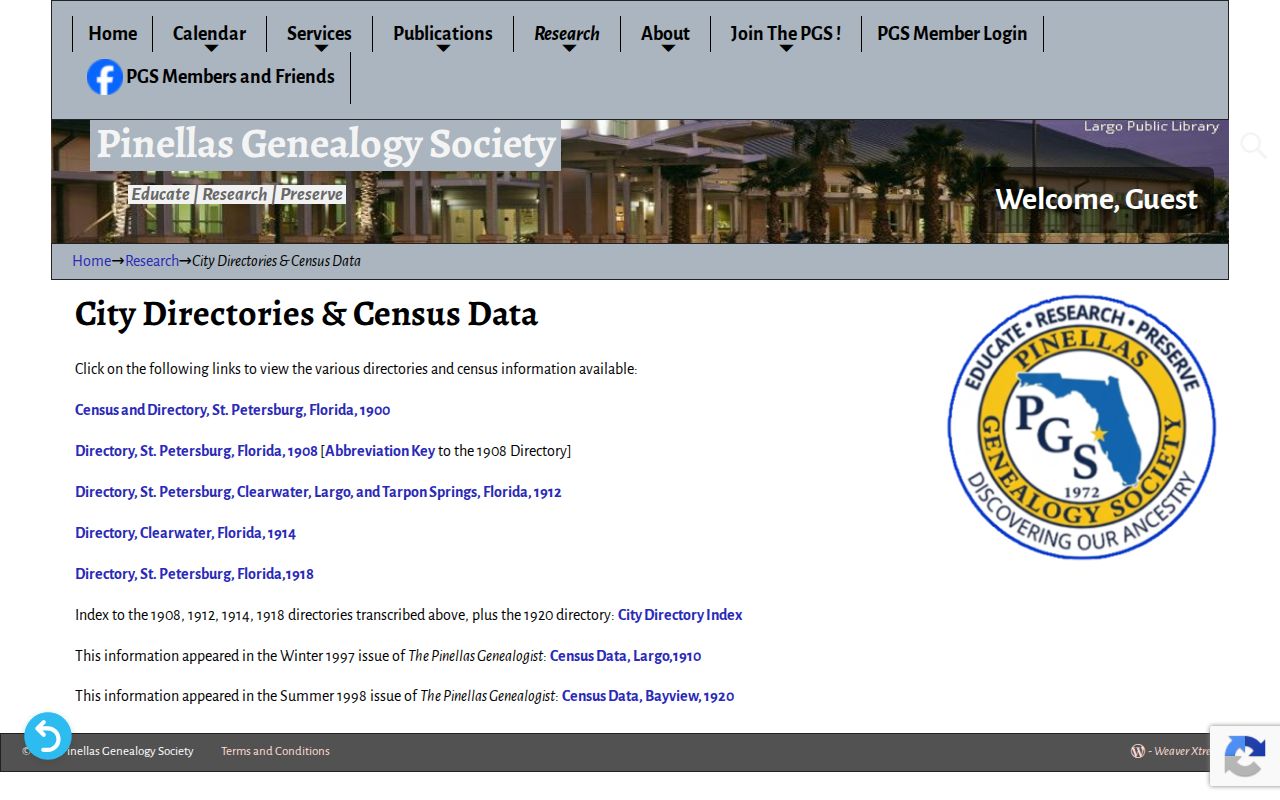
The captured collection gives a direct route to early names and combined indexes.
For physical access, Heritage Village preserves county sources. The Museum of History archival library takes appointments. The State Library directory collection is available in Tallahassee. Contact a repository first when rules depend on an appointment or on-site use.
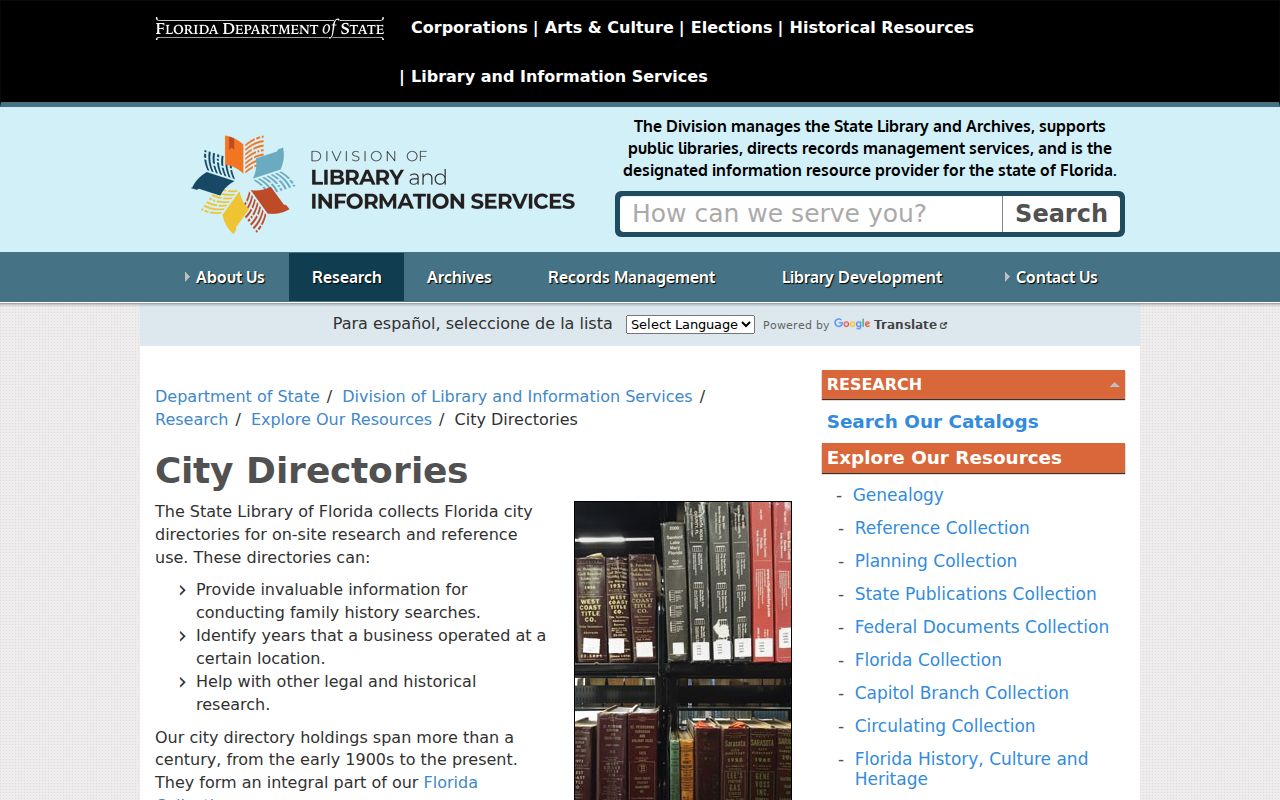
The statewide shelf can fill a local gap and clarify a multi-city title.
Trace St. Petersburg Households
A city directory works best as a sequence. Record the exact title and year. Keep original spelling, initials, spouse, work line, and address. Never fill a skipped year with a guess.
- Normalize the old address with street indexes, plats, and Sanborn maps. Ordinance 617-A changed many names and numbers in 1928.
- Search all surname and initial forms. Decode spouse, widow, occupation, and “res same.”
- Repeat in adjacent available editions, accounting for nonpublication years.
- Use a reverse section to inspect the street, then return to the alphabetical list.
- Pair editions with released census schedules. Check pre-1912 county material under Hillsborough.
- Confirm ownership with parcel and deed records, then add newspaper or probate evidence.
For the current address chain, use the St. Petersburg Street Directory. Historical directory work preserves what the printed entry meant in its own year.
St. Petersburg Street Numbers Shifted
Ordinance 617-A, adopted January 9, 1928, renamed and renumbered dozens of streets. The same home can seem to vanish. Search the old printed address first, then bridge it with plats, directory cross-references, and a Sanborn sheet before assigning a modern number.
Development also shapes the trail. Downtown and Old Northeast reflect early growth. Roser Park and Kenwood preserve bungalow-era evidence. Snell Isle and Jungle Prada connect to the 1920s boom. The former Gas Plant community requires care because roads and clearance changed its fabric. Map year, subdivision, and neighborhood context can separate people who share a name.
Context for St. Petersburg Residents
Maps and newspapers turn a terse line into a testable account. The Museum lists Sanborn maps for 1918, 1939, and 1952. The library offers the Tampa Bay Times archive for 1901–2009. Staff will search up to three obituaries when given a full name and death date, check through two weeks after that date, and can mail or email a scan. The service is prepaid at $15 per obituary and asks ten working days.
The Weekly Challenger adds Black community reporting, though USF descriptions differ on its precise digitized start. Check date facets. The Gas Plant project pairs a 1918 Sanborn sheet and directory page with newspapers and oral history, restoring context absent from a name line.
Review USF St. Petersburg Special Collections access.
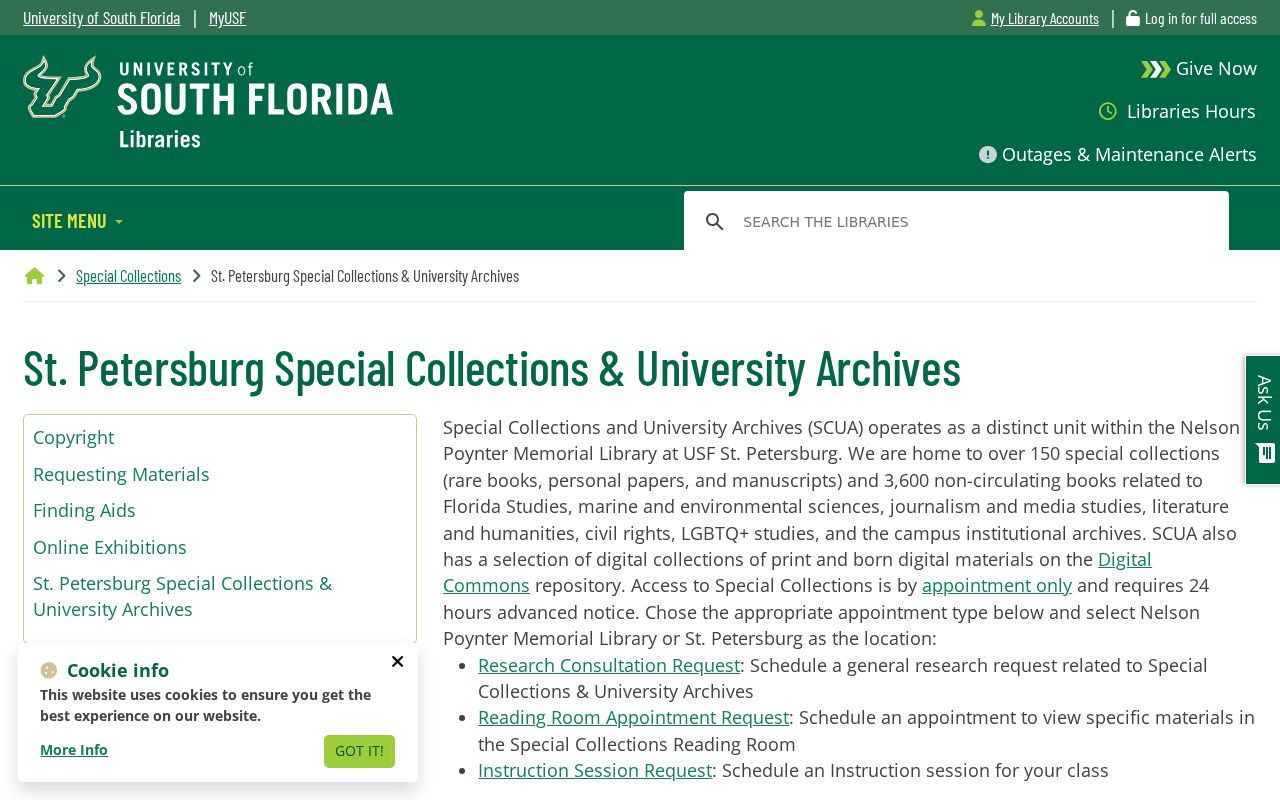
The archive page points toward photographs, journalism, and civic records that corroborate residents.
St. Petersburg Directory Family Research
Family history works best when each claim has two sources. A spouse, occupation, and residence can distinguish matching initials. A census can reveal the household. An obituary may add survivors and former places. Probate can identify heirs, while a deed shows legal title. None should be forced to say more than it records.
Absence may mean a skipped year, omission, a boarder listed under the household head, or an address under the old grid. Preserve those options until another source resolves them. This method can reconnect relatives with dated evidence instead of a broad commercial profile.